
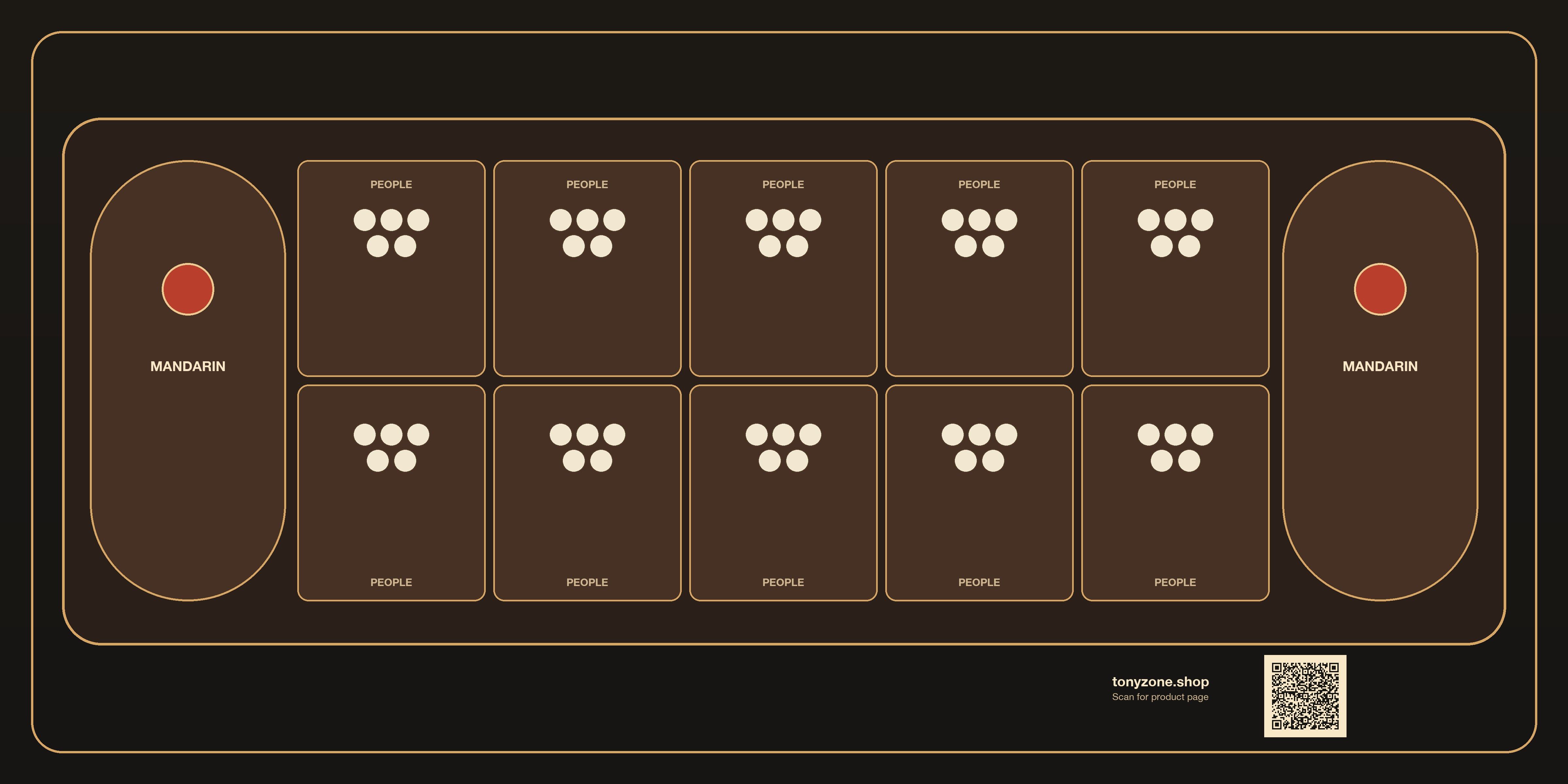
A good desk mat usually disappears under the keyboard. This one does the opposite. The O An Quan Vietnamese Mancala Desk Mat turns the surface in front of you into a playable board, so the object is not only background texture for a setup photo. It has a job. It gives your hands somewhere to land, your mouse somewhere smooth to move, and your table a small invitation to slow down and play.
The design choice that matters most is restraint. Instead of printing a full rulebook across the mat, the final layout gives the board most of the available space. On a 16 inch by 32 inch surface, that is the right trade. O An Quan needs room for the two Mandarin fields, the ten people fields, and enough negative space around the board that real pieces feel comfortable to move. A crowded novelty mat would look informative but play badly. A clean board-first mat can actually be used.
Why a board game belongs on a desk mat
Desk mats already behave like small territories. They define where the keyboard sits, where the mouse travels, where a mug is not supposed to go, and where a notebook can be opened without scraping against the desk. A board game mat uses that same territory more intentionally. It says the desk can be a place for work and a place for a short ritual. That is especially fitting for O An Quan, a game that depends on touch, counting, rhythm, and the satisfying movement of small pieces from one field to the next.
The format also solves a practical problem. Traditional boards can be drawn on paper, carved into wood, or improvised on the floor, but a desk mat is always ready. Leave a few stones, seeds, glass beads, or Go pieces nearby and the board becomes part of the room. You do not have to find a box, unfold a board, or clear a whole table. The game is already sitting where you spend time.
The layout: large board first, branding second
The final product keeps the playable board as the main character. The board stretches across most of the mat, with two oval Mandarin fields at the ends and ten rectangular people fields in the center. The markings are high-contrast enough to read on a dark workspace, but they avoid the busy decorative framing that can make a mat feel like a poster. The small TonyZone link and QR code sit at the edge so they are useful without competing with play.
That quiet approach makes the mat easier to live with. A game-board desk mat should not shout all day when the game is not being played. It has to sit under a laptop, a mechanical keyboard, a sketchbook, or a pair of headphones and still feel like part of a considered setup. Dark brown, black, cream, and warm gold give it a classic board-game mood without turning the desk into a museum display.
How it works in real use
To play, use small objects you already have: stones from a craft jar, smooth beads, seeds, shells, or black and white Go pieces. The pieces do not need to match perfectly. In fact, a little material variation makes the game feel more personal. The board is printed directly onto the mat, so the fields stay in place while the pieces move. That matters during capture sequences, where players need to read empty and occupied fields quickly.
The 16 inch by 32 inch size is important here. Smaller desk mats are fine for graphic decoration, but O An Quan benefits from breathing room. The fields need to be large enough for fingers, not just eyes. A mat this wide can still hold a keyboard and mouse when used as a normal workspace mat, but when it is time to play, the board has enough scale to feel intentional rather than squeezed.
A Vietnamese game, presented as everyday design
O An Quan carries a familiar childhood energy for many Vietnamese families: counting pieces, choosing a direction, watching a field empty out, and hoping the next move creates a capture. Turning that into a desk object is not about making the game more complicated. It is about making it visible again. A board printed on a daily surface keeps the memory available, even in a modern desk setup full of screens and chargers.
That is why the mat works as a gift. It does not require the receiver to be a collector of board games. It can be for someone who grew up with the game, someone learning about Vietnamese culture, a student who likes tactile games, or a remote worker whose desk could use something more personal than another plain black pad. It gives the room a story without forcing the story into a long paragraph on the product itself.
Where it fits in a setup
The mat pairs best with calm hardware: black or charcoal keyboards, off-white keycaps, wood desks, warm desk lamps, and simple storage trays for the playing pieces. If your setup already uses a minimal palette, the board adds structure without adding visual noise. If your setup is more playful, the mat gives the playfulness a purpose. It is not just a pattern; it is a surface with rules.
For shoppers browsing TonyZone desk pieces, the O An Quan mat sits between decor and function. You can view the product page for the O An Quan Vietnamese Mancala Desk Mat or explore more TonyZone desk mats if you want the same workspace scale with a different mood. The key is that this one is built around interaction. It earns its size by giving you something to do with it.
The best version is the simplest one
The earlier temptation with a cultural game mat is to explain everything on the surface: history, setup, rules, scoring, and examples. That can be useful on a reference card, but it is not always good product design. A desk mat has to be read from a distance, lived with for months, and used under real objects. For this product, the better solution is a clean playable board with a QR code for the product page. The mat stays beautiful, and the extra information can live online.
That balance is what makes the design feel finished. It respects O An Quan as a game of movement, not just as a graphic reference. It respects the desk mat as a physical object, not just as a rectangle to fill. And it respects the customer, who can understand the idea at a glance: this is a beautiful surface, and yes, you can actually play on it.
FAQ
What pieces can I use with the O An Quan desk mat?
Use anything small and easy to pick up: stones, seeds, glass beads, shells, coins, or Go pieces. A larger piece or a different color works well for each Mandarin field.
Is the mat only for playing?
No. It works as a normal desk mat for a keyboard, mouse, notebook, or laptop. The board layout is printed into the design, so it can be part of the workspace even when no game is happening.
Why does this version avoid long instructions on the mat?
The board needs space to be playable. Keeping the surface minimal makes the fields larger and easier to use. The QR code and TonyZone link give shoppers a clean path back to the product page without covering the mat in small text.



No comments yet